

The All-in-One System for Modern Mental Healthcare Providers.
Built for counselors, therapists, psychologists, psychiatrists and mental health practitioners — manage your practice with tools designed for how you work.

Designed for the Full Spectrum of Mental Health Specialists.

Occupational Therapists
Occupational Therapists
Manage functional assessments, goal tracking, and rehabilitation plans built for occupational therapy workflows.
- Functional assessment tools
- Goal & progress tracking
- Rehab plan management

Licensed Therapists & Counselors
Licensed Therapists & Counselors
Structured session notes, digital intake, risk monitoring and outcome tracking for therapy and counseling practices.
- Session documentation
- Digital intake forms
- Risk monitoring tools

Clinical Psychologists
Clinical Psychologists
Assessment scoring, psychological reporting, and longitudinal patient tracking for clinical psychology practices.
- Assessment scoring
- Psychological reporting
- Longitudinal tracking
Structured Onboarding
from the First Appointment.
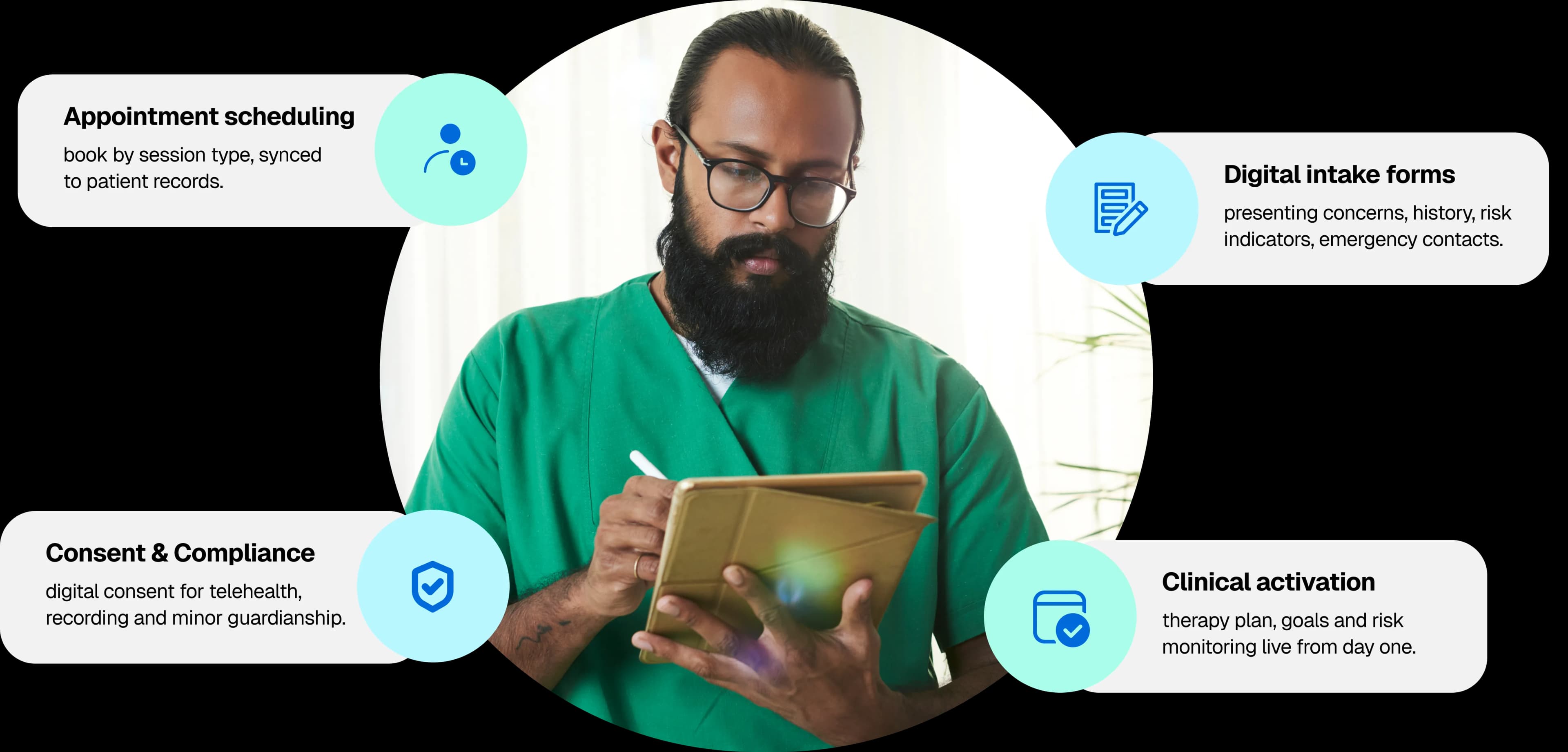


Appointment scheduling
book by session type, synced to patient records.

Consent & Compliance
digital consent for telehealth, recording and minor guardianship.

Digital intake forms
presenting concerns, history, risk indicators, emergency contacts.

Clinical activation
therapy plan, goals and risk monitoring live from day one.
Every Session Structured.

Measure Symptoms. Track Change. Deliver Evidence-Based Care.
Pre-configured instruments
PHQ-9, GAD-7, DASS-21, PCL-5, BDI-II, BAI, PSS-10 with automated scoring.
Baseline & ongoing measurement
assigned at intake, mid-treatment and discharge.
Severity classification
scores auto-map to Minimal / Mild / Moderate / Severe; risk items trigger alerts.
Trend analysis
visual progress graphs showing symptom reduction, stability and deterioration.
Quality detection
flags straight-line responses and inconsistent completion patterns.
Proactive Risk Detection Built Into Every Stage of Care.
- 01
Assessment-level detection
PHQ-9 item 9, PCL-5 and DASS-21 thresholds trigger automatic review.
- 02
Session-level monitoring
structured risk fields per session; flags created instantly if risk escalates.
- 03
Escalation workflows
supervisor notifications, multi-channel alerts, acknowledgment logging.
- 04
Audit trails
every risk event logged with time, actions taken and resolution status.
- 05
Resolution & continuity
flags stay active until resolved; follow-up sessions reference prior flags.


Demonstrate Progress. Document Impact. Close the Loop.
- 01
Baseline vs. final comparison auto-calculates score improvement and severity reduction.
- 02
Longitudinal trend analysis visualise rapid response, plateau and relapse patterns.
- 03
Goal achievement tracking goals achieved, partially achieved or pending at discharge.
- 04
Attendance & engagement metrics session rate, missed appointments, homework compliance.
- 05
Structured discharge summaries baseline scores, final scores, sessions attended, aftercare and referrals.
Structured Data That Powers Intelligent Mental Healthcare.
- 01
Treatment progress analytics response speed, improvement trajectories, plateau and relapse detection.
- 02
Risk pattern detection combines assessment trends, session risk and behavioural patterns.
- 03
Dropout & engagement insights attendance trends, missed sessions, early disengagement signals.
- 04
Clinical note intelligence symptom trend extraction, intervention pattern recognition (NLP-ready).
- 05
Population-level insights outcome trends by provider, modality and programme for NGOs and enterprise.


Confidential. Controlled. Compliant by Design.
- 01
Role-based access control therapist, psychiatrist, supervisor, billing and admin roles defined.
- 02
Organisation-scoped multi-tenancy isolated data boundaries per clinic, NGO or department.
- 03
Consent governance telehealth, recording and minor guardianship consent tracked and time-stamped.
- 04
Audit trails & activity logs record edits, risk flags, consent updates and escalations logged.
- 05
Secure infrastructure encrypted transmission, secure cloud hosting, continuous uptime monitoring.
Deliver Better Care. Operate More Efficiently. Demonstrate Real Impact.
Financial Workflows Designed for Mental Healthcare.
Session-based billing
auto-generated per session type, provider, duration and modality.
Service-level pricing
individual, group, family, psychiatric and telehealth sessions configurable.
Multi-participant billing
group and family sessions tracked and billed per participant.
Telehealth billing
documented and billed within the same system, linked to consent logs.
Revenue visibility
track by provider, service, location and programme.
Insurance & grant support
exportable summaries for reimbursement, donor and funder reporting.

FAQs
Tymira360 is an all-in-one practice management and clinical documentation platform designed for mental healthcare organizations. It enables providers to manage appointments, intake forms, therapy sessions, clinical notes, billing, patient records, and reporting within one structured system.
Tymira360 supports solo therapists, psychology and psychiatry practices, counseling centers, rehabilitation centers, NGOs delivering mental health programmes, and hospital mental health departments. The system scales from individual providers to large organizations.
Yes. Tymira360 supports structured clinical assessments including PHQ-9, GAD-7, and DASS-21. Providers can assign assessments, track scores over time, and monitor patient progress through structured reporting — enabling evidence-based treatment and measurable clinical outcomes.
Yes. Tymira360 provides structured documentation templates including SOAP notes, progress notes, and therapy session formats. These reduce repetitive documentation work and allow clinicians to focus more on patient care.
Yes. Tymira360 supports both in-person and virtual therapy workflows including scheduling, session documentation, and follow-up management. Providers can manage all sessions within one unified workflow.
Tymira360 provides structured patient management including digital intake forms, patient records, treatment plans, session history, assessment tracking, and follow-up scheduling — giving a complete longitudinal view of each patient's care journey.
Yes. Tymira360 allows mental health providers to generate invoices, track payments, manage outstanding balances, and produce financial reports — improving revenue tracking and financial control.
Yes. Tymira360 supports multi-provider organizations with staff scheduling, role-based permissions, provider performance tracking, and multi-location management. Organizations can coordinate teams while maintaining operational control.
Tymira360 includes enterprise-grade security controls including role-based access permissions, activity audit logs, and secure infrastructure architecture. These controls support the protection of sensitive mental health data and comply with Kenya's ODPC data protection requirements.
Organizations can begin by requesting a demo to understand how the platform fits their workflow. After onboarding, providers configure services, staff, documentation processes, and financial settings. Average setup time is 7–14 days with full onboarding support included.
Mental Healthcare Deserves Structured Infrastructure.
Many providers operate with fragmented systems never designed for mental healthcare.
REQUEST A DEMO